Releases: huggingface/transformers
Patch v4.55.4

Patch release v4.55.3
Patch release 4.55.3
Focused on stabilizing FlashAttention-2 on Ascend NPU, improving FSDP behavior for generic-task models, fixing MXFP4 integration for GPT-OSS
Bug Fixes & Improvements
- FlashAttention-2 / Ascend NPU – Fix “unavailable” runtime error (#40151) by @FightingZhen
- FlashAttention kwargs – Revert FA kwargs preparation to resolve regression (#40161) by @Cyrilvallez
- FSDP (generic-task models) – Fix sharding/runtime issues (#40191) by @Cyrilvallez
- GPT-OSS / MXFP4 – Ensure swiglu_limit is correctly passed through (#40197) by @danielhanchen
- Mamba – Fix cache handling to prevent stale/incorrect state (#40203) by @manueldeprada
- Misc – Minor follow-up fix addressing #40262 by @ArthurZucker
Contributors


Assets 2
Patch release 4.55.2: for FA2 users!
Patch release 4.55.2!
only affects FA2 generations!
😢 Well sorry everyone, sometimes shit can happen...
4.55.1 was broken because of 🥁 git merge conflict.
I cherry-picked #40002 without having #40029 , thus from ..modeling_flash_attention_utils import prepare_fa_kwargs_from_position_ids is missing, and since this is a slow test, nothing caught it.
Will work to remediate and write the post-mortem when yanking the release.
Patch release 4.55.1
Patch release 4.55.1:
Mostly focused around stabalizing the Mxfp4 for GPTOSS model!
Bug Fixes & Improvements
- Idefics2, Idefics3, SmolVLM – Fix tensor device issue (#39975) by @qgallouedec
- Merge conflicts – Fix merge conflicts from previous changes by @vasqu
- MXFP4 / CPU device_map – Default to dequantize when CPU is in device_map (#39993) by @MekkCyber
- GPT Big Code – Fix attention scaling (#40041) by @vasqu
- Windows compatibility – Resolve Triton version check compatibility (#39986) by @Tsumugii24 @MekkCyber
- Gemma3n model – Add missing None default values for get_placeholder_mask (#39991, #40024) by @Znerual
- Fuyu model – Fix broken image inference (#39915) by @Isotr0py
- PerceptionLM – Fix missing video inputs (#39971) by @shuminghu
- Idefics – Fix device mismatch (#39981) by @zucchini-nlp
- Triton kernels – Remove triton_kernels dependency in favor of included kernels (#39926) by @SunMarc
- GPT-OSS MXFP4 – Enable on older hardware (sm75+) (#39940) by @matthewdouglas @SunMarc
- MXFP4 quantizer – Allow CPU inference with dequantize option (#39953) by @returnL
CI & Build
- CI stability – Post-GPT-OSS fixes for green CI (#39929) by @gante @LysandreJik
Contributors


Assets 2
GLM-4.5V preview based on 4.55.0
GLM-4.5V preview based on 4.55.0
New model added by the Z.ai team to transformers!
GLM-4.5V is a new multimodal reasoning model based on GLM-4.5-Air, which has 106B total and 12B active parameters.
It's performant across 42 benchmarks across various categories:
- Image reasoning (scene understanding, complex multi-image analysis, spatial recognition)
- Video understanding (long video segmentation and event recognition)
- GUI tasks (screen reading, icon recognition, desktop operation assistance)
- Complex chart & long document parsing (research report analysis, information extraction)
- Grounding (precise visual element localization)

To use, install transformers release branch.
pip install transformers-v4.55.0-GLM-4.5V-previewThen you can run:
from transformers import AutoProcessor, Glm4vMoeForConditionalGeneration
import torch

MODEL_PATH = "zai-org/GLM-4.5V"
messages = [
    {
        "role": "user",
        "content": [
            {
                "type": "image",
                "url": "https://upload.wikimedia.org/wikipedia/commons/f/fa/Grayscale_8bits_palette_sample_image.png"
            },
            {
                "type": "text",
                "text": "describe this image"
            }
        ],
    }
]
processor = AutoProcessor.from_pretrained(MODEL_PATH)
model = Glm4vMoeForConditionalGeneration.from_pretrained(
    pretrained_model_name_or_path=MODEL_PATH,
    torch_dtype="auto",
    device_map="auto",
)
inputs = processor.apply_chat_template(
    messages,
    tokenize=True,
    add_generation_prompt=True,
    return_dict=True,
    return_tensors="pt"
).to(model.device)
inputs.pop("token_type_ids", None)
generated_ids = model.generate(**inputs, max_new_tokens=8192)
output_text = processor.decode(generated_ids[0][inputs["input_ids"].shape[1]:], skip_special_tokens=False)
print(output_text)v4.55.0: New openai GPT OSS model!

Welcome GPT OSS, the new open-source model family from OpenAI!

For more detailed information about this model, we recommend reading the following blogpost: https://huggingface.co/blog/welcome-openai-gpt-oss
GPT OSS is a hugely anticipated open-weights release by OpenAI, designed for powerful reasoning, agentic tasks, and versatile developer use cases. It comprises two models: a big one with 117B parameters (gpt-oss-120b), and a smaller one with 21B parameters (gpt-oss-20b). Both are mixture-of-experts (MoEs) and use a 4-bit quantization scheme (MXFP4), enabling fast inference (thanks to fewer active parameters, see details below) while keeping resource usage low. The large model fits on a single H100 GPU, while the small one runs within 16GB of memory and is perfect for consumer hardware and on-device applications.
Overview of Capabilities and Architecture
- 21B and 117B total parameters, with 3.6B and 5.1B active parameters, respectively.
- 4-bit quantization scheme using mxfp4 format. Only applied on the MoE weights. As stated, the 120B fits in a single 80 GB GPU and the 20B fits in a single 16GB GPU.
- Reasoning, text-only models; with chain-of-thought and adjustable reasoning effort levels.
- Instruction following and tool use support.
- Inference implementations using transformers, vLLM, llama.cpp, and ollama.
- Responses API is recommended for inference.
- License: Apache 2.0, with a small complementary use policy.
Architecture
- Token-choice MoE with SwiGLU activations.
- When calculating the MoE weights, a softmax is taken over selected experts (softmax-after-topk).
- Each attention layer uses RoPE with 128K context.
- Alternate attention layers: full-context, and sliding 128-token window.
- Attention layers use a learned attention sink per-head, where the denominator of the softmax has an additional additive value.
- It uses the same tokenizer as GPT-4o and other OpenAI API models.
- Some new tokens have been incorporated to enable compatibility with the Responses API.
The following snippet shows simple inference with the 20B model. It runs on 16 GB GPUs when using mxfp4, or ~48 GB in bfloat16.
from transformers import AutoModelForCausalLM, AutoTokenizer

model_id = "openai/gpt-oss-20b"

tokenizer = AutoTokenizer.from_pretrained(model_id)
model = AutoModelForCausalLM.from_pretrained(
    model_id,
    device_map="auto",
    torch_dtype="auto",
)

messages = [
    {"role": "user", "content": "How many rs are in the word 'strawberry'?"},
]

inputs = tokenizer.apply_chat_template(
    messages,
    add_generation_prompt=True,
    return_tensors="pt",
    return_dict=True,
).to(model.device)

generated = model.generate(**inputs, max_new_tokens=100)
print(tokenizer.decode(generated[0][inputs["input_ids"].shape[-1]:]))
Flash Attention 3
The models use attention sinks, a technique the vLLM team made compatible with Flash Attention 3. We have packaged and integrated their optimized kernel in kernels-community/vllm-flash-attn3. At the time of writing, this super-fast kernel has been tested on Hopper cards with PyTorch 2.7 and 2.8. We expect increased coverage in the coming days. If you run the models on Hopper cards (for example, H100 or H200), you need to pip install –upgrade kernels and add the following line to your snippet:
from transformers import AutoModelForCausalLM, AutoTokenizer

model_id = "openai/gpt-oss-20b"

tokenizer = AutoTokenizer.from_pretrained(model_id)
model = AutoModelForCausalLM.from_pretrained(
    model_id,
    device_map="auto",
    torch_dtype="auto",
+    # Flash Attention with Sinks
+    attn_implementation="kernels-community/vllm-flash-attn3",
)

messages = [
    {"role": "user", "content": "How many rs are in the word 'strawberry'?"},
]

inputs = tokenizer.apply_chat_template(
    messages,
    add_generation_prompt=True,
    return_tensors="pt",
    return_dict=True,
).to(model.device)

generated = model.generate(**inputs, max_new_tokens=100)
print(tokenizer.decode(generated[0][inputs["input_ids"].shape[-1]:]))
Even though the 120B model fits on a single H100 GPU (using mxfp4), you can also run it easily on multiple GPUs using accelerate or torchrun. Transformers provides a default parallelization plan, and you can leverage optimized attention kernels as well. The following snippet can be run with torchrun --nproc_per_node=4 generate.py on a system with 4 GPUs:
from transformers import AutoModelForCausalLM, AutoTokenizer
from transformers.distributed import DistributedConfig
import torch

model_path = "openai/gpt-oss-120b"
tokenizer = AutoTokenizer.from_pretrained(model_path, padding_side="left")

device_map = {
    "tp_plan": "auto",    # Enable Tensor Parallelism
}

model = AutoModelForCausalLM.from_pretrained(
    model_path,
    torch_dtype="auto",
    attn_implementation="kernels-community/vllm-flash-attn3",
    **device_map,
)

messages = [
     {"role": "user", "content": "Explain how expert parallelism works in large language models."}
]

inputs = tokenizer.apply_chat_template(
    messages,
    add_generation_prompt=True,
    return_tensors="pt",
    return_dict=True,
).to(model.device)

outputs = model.generate(**inputs, max_new_tokens=1000)

# Decode and print
response = tokenizer.decode(outputs[0])
print("Model response:", response.split("<|channel|>final<|message|>")[-1].strip())
Other optimizations
If you have a Hopper GPU or better, we recommend you use mxfp4 for the reasons explained above. If you can additionally use Flash Attention 3, then by all means do enable it!
Tip
If your GPU is not compatible with mxfp4, then we recommend you use MegaBlocks MoE kernels for a nice speed bump. To do so, you just need to adjust your inference code like this:
from transformers import AutoModelForCausalLM, AutoTokenizer

model_id = "openai/gpt-oss-20b"

tokenizer = AutoTokenizer.from_pretrained(model_id)
model = AutoModelForCausalLM.from_pretrained(
    model_id,
    device_map="auto",
    torch_dtype="auto",
+    # Optimize MoE layers with downloadable MegaBlocksMoeMLP
+    use_kernels=True,
)

messages = [
    {"role": "user", "content": "How many rs are in the word 'strawberry'?"},
]

inputs = tokenizer.apply_chat_template(
    messages,
    add_generation_prompt=True,
    tokenize=True,
    return_tensors="pt",
    return_dict=True,
).to(model.device)

generated = model.generate(**inputs, max_new_tokens=100)
print(tokenizer.decode(generated[0][inputs["input_ids"].shape[-1]:]))
Tip
MegaBlocks optimized MoE kernels require the model to run on bfloat16, so memory consumption will be higher than running on mxfp4. We recommend you use mxfp4 if you can, otherwise opt in to MegaBlocks via use_kernels=True.
transformers serve
You can use transformers serve to experiment locally with the models, without any other dependencies. You can launch the server with just:
transformers serve
To which you can send requests using the Responses API.
# responses API
curl -X POST http://localhost:8000/v1/responses \
-H "Content-Type: application/json" \
-d '{"input": [{"role": "system", "content": "hello"}], "temperature": 1.0, "stream": true, "model": "openai/gpt-oss-120b"}'
You can also send requests using the standard Completions API:
# completions API
curl -X POST http://localhost:8000/v1/chat/completions \
-H "Content-Type: application/json" \
-d '{"messages": [{"role": "system", "content": "hello"}], "temperature": 1.0, "max_tokens": 1000, "stream": true, "model": "openai/gpt-oss-120b"}'
Command A Vision

Command A Vision is a state-of-the-art multimodal model designed to seamlessly integrate visual and textual information for a wide range of applications. By combining advanced computer vision techniques with natural language processing capabilities, Command A Vision enables users to analyze, understand, and generate insights from both visual and textual data.
The model excels at tasks including image captioning, visual question answering, document understanding, and chart understanding. This makes it a versatile tool for AI practitioners. Its ability to process complex visual and textual inputs makes it useful in settings where text-only representations are imprecise or unavailable, like real-world image understanding and graphics-heavy document processing.
Command A Vision is built upon a robust architecture that leverages the latest advancements in VLMs. It's highly performant and efficient, even when dealing with large-scale datasets. The model's flexibility makes it suitable for a wide range of use cases, from content moderation and image search to medical imaging analysis and robotics.
- [Model] Cohere2 Vision by @zucchini-nlp in #39810
MM Grounding DINO

MM Grounding DINO model was proposed in An Open and Comprehensive Pipeline for Unified Object Grounding and Detection by Xiangyu Zhao, Yicheng Chen, Shilin Xu, Xiangtai Li, Xinjiang Wang, Yining Li, Haian Huang>.
MM Grounding DINO improves upon the [G...
Contributors


Assets 2
Patch release 4.54.1
Patch release 4.54.1
We had quite a lot of bugs that got through! Release was a bit rushed, sorry everyone! 🤗
Mostly cache fixes, as we now have layered cache, and fixed to distributed.
- Fix Cache.max_cache_len max value for Hybrid models, @manueldeprada, @Cyrilvallez, #39737
- [modenbert] fix regression, @zucchini-nlp, #39750
- Fix version issue in modeling_utils.py, @Cyrilvallez, #39759
- Fix GPT2 with cross attention, @zucchini-nlp, #39754
- Fix mamba regression, @manueldeprada, #39728
- Fix: add back base model plan, @S1ro1, #39733
- fix cache inheritance, #39748
- Fix cache-related tests, @zucchini-nlp, #39676
- Fix Layer device placement in Caches, @Cyrilvallez, #39732
- PATCH: add back n-dim device-mesh + fix tp trainer saving, @S1ro1, @SunMarc, #39693
- fix missing model._tp_size from ep refactor, @winglian, #39688
Contributors
Assets 2
v4.54.0: Kernels, Transformers Serve, Ernie, Voxtral, LFM2, DeepSeek v2, ModernBERT Decoder...
Important news!
In order to become the source of truth, we recognize that we need to address two common and long-heard critiques about transformers:
transformersis bloatedtransformersis slow
Our team has focused on improving both aspects, and we are now ready to announce this.
The modeling files for the standard Llama models are down to 500 LOC and should be much more readable, keeping just the core of the modeling and hiding the "powerful transformers features."

The MoEs are getting some kernel magic, enabling the use of the efficient megablocks kernels, setting a good precedent to allow the community to leverage any of the most powerful kernels developed for quantization as well!
It should also be much more convenient to use with any attention implementation you want. This opens the door to some optimizations such as leveraging flash-attention on Metal (MPS Torch backend).

This is but the tip of the iceberg: with the work on kernels that we're heavily pushing forward, expect speed-ups on several backends in the coming months!!
This release also includes the first steps to enabling efficient distributed training natively in transformers. Loading a 100B model takes ~3 seconds on our cluster — we hope this will be the norm for everyone! We are working on distributed checkpointing as well, and want to make sure our API can be easily used for any type of parallelism.
We want the community to benefit from all of the advances, and as always, include all hardware and platforms! We believe the kernels library will give the tools to optimize everything, making a big difference for the industry!
New models
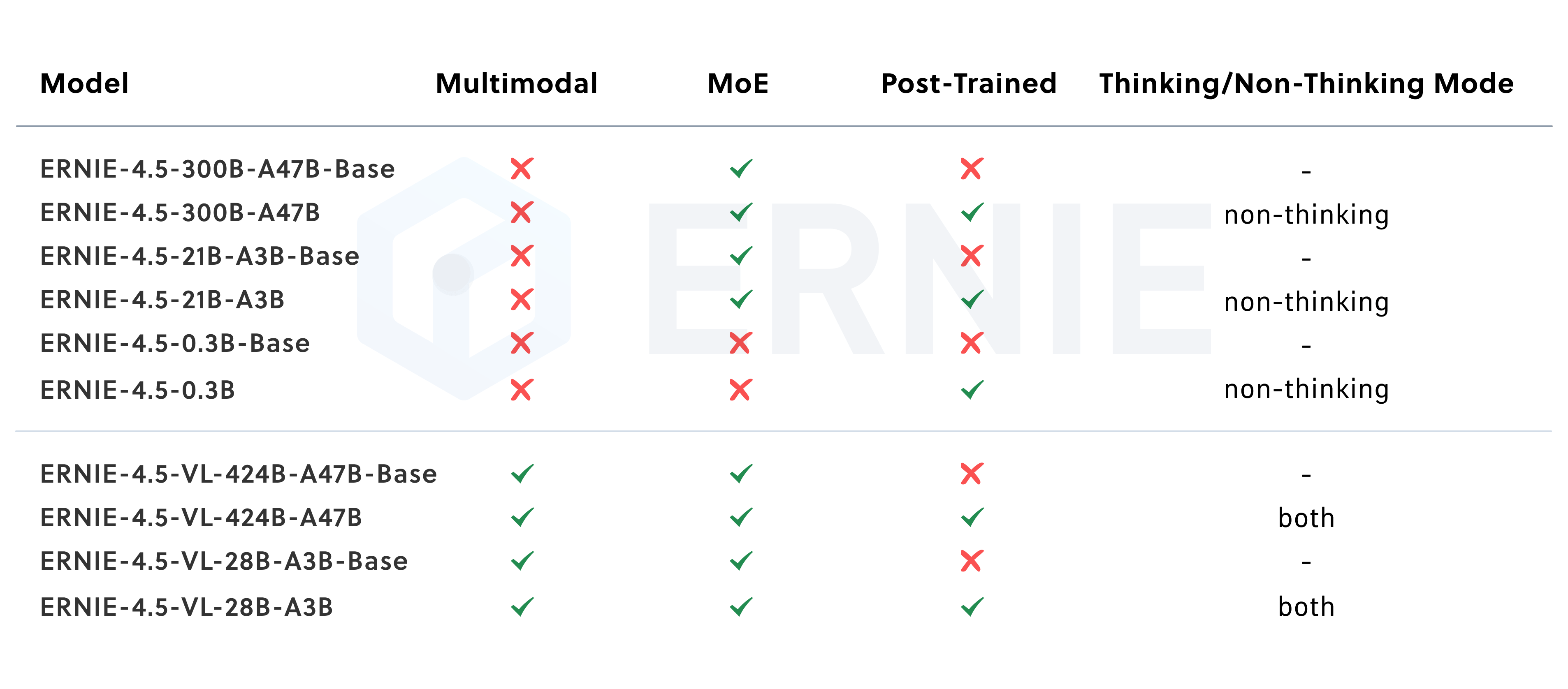
Ernie 4.5
The Ernie 4.5 model was released in the Ernie 4.5 Model Family release by baidu.
This family of models contains multiple different architectures and model sizes. This model in specific targets the base text
model without mixture of experts (moe) with 0.3B parameters in total. It uses the standard Llama at its core.
Other models from the family can be found at Ernie 4.5 MoE.
Voxtral
Voxtral is an upgrade of Ministral 3B and Mistral Small 3B, extending its language capabilities with audio input support. It is designed to handle tasks such as speech transcription, translation, and audio understanding.
You can read more in Mistral's realease blog post.
The model is available in two checkpoints:
Key Features
Voxtral builds on Ministral-3B by adding audio processing capabilities:
- Transcription mode: Includes a dedicated mode for speech transcription. By default, Voxtral detects the spoken language and transcribes it accordingly.
- Long-form context: With a 32k token context window, Voxtral can process up to 30 minutes of audio for transcription or 40 minutes for broader audio understanding.
- Integrated Q&A and summarization: Supports querying audio directly and producing structured summaries without relying on separate ASR and language models.
- Multilingual support: Automatically detects language and performs well across several widely spoken languages, including English, Spanish, French, Portuguese, Hindi, German, Dutch, and Italian.
- Function calling via voice: Can trigger functions or workflows directly from spoken input based on detected user intent.
- Text capabilities: Maintains the strong text processing performance of its Ministral-3B foundation.
LFM2
LFM2 represents a new generation of Liquid Foundation Models developed by Liquid AI, specifically designed for edge AI and on-device deployment.
The models are available in three sizes (350M, 700M, and 1.2B parameters) and are engineered to run efficiently on CPU, GPU, and NPU hardware, making them particularly well-suited for applications requiring low latency, offline operation, and privacy.
- LFM2 by @paulpak58 in #39340
DeepSeek v2
The DeepSeek-V2 model was proposed in DeepSeek-V2: A Strong, Economical, and Efficient Mixture-of-Experts Language Model by DeepSeek-AI Team.
The model uses Multi-head Latent Attention (MLA) and DeepSeekMoE architectures for efficient inference and cost-effective training. It employs an auxiliary-loss-free strategy for load balancing and multi-token prediction training objective. The model can be used for various language tasks after being pre-trained on 14.8 trillion tokens and going through Supervised Fine-Tuning and Reinforcement Learning stages.
- Add DeepSeek V2 Model into Transformers by @VladOS95-cyber in #36400
ModernBERT Decoder models
ModernBERT Decoder is the same architecture as ModernBERT but trained from scratch with a causal language modeling (CLM) objective. This allows for using the same architecture for comparing encoders and decoders. This is the decoder architecture implementation of ModernBERT, designed for autoregressive text generation tasks.
Like the encoder version, ModernBERT Decoder incorporates modern architectural improvements such as rotary positional embeddings to support sequences of up to 8192 tokens, unpadding to avoid wasting compute on padding tokens, GeGLU layers, and alternating attention patterns. However, it uses causal (unidirectional) attention to enable autoregressive generation.
EoMT
The Encoder-only Mask Transformer (EoMT) model was introduced in the CVPR 2025 Highlight Paper Your ViT is Secretly an Image Segmentation Model by Tommie Kerssies, Niccolò Cavagnero, Alexander Hermans, Narges Norouzi, Giuseppe Averta, Bastian Leibe, Gijs Dubbelman, and Daan de Geus.
EoMT reveals Vision Transformers can perform image segmentation efficiently without task-specific components.

- ✨ Add EoMT Model || 🚨 Fix Mask2Former loss calculation by @yaswanth19 in #37610
Doge
Doge is a series of small language models based on the Doge architecture, aiming to combine the advantages of state-space and self-attention algorithms, calculate dynamic masks from cached value states using the zero-order hold method, and solve the problem of existing mainstream language models getting lost in context. It uses the wsd_scheduler scheduler to pre-train on the smollm-corpus, and can continue training on new datasets or add sparse activation feedforward networks from stable stage checkpoints.
<img src="https://huggingface.co/datasets/huggingface/documentation-images/resolve/refs%2Fpr%2F426/transformers/model_doc/doge_architecture.png" alt="drawing" width="600"
- Add Doge model by @LoserCheems in #35891
AIM v2
The AIMv2 model was proposed in Multimodal Autoregressive Pre-training of Large Vision Encoders by Enrico Fini, Mustafa Shukor, Xiujun Li, Philipp Dufter, Michal Klein, David Haldimann, Sai Aitharaju, Victor Guilherme Turrisi da Costa, Louis Béthune, Zhe Gan, Alexander T Toshev, Marcin Eichner, Moin Nabi, Yinfei Yang, Joshua M. Susskind, Alaaeldin El-Nouby.
The abstract from the paper is the following:
We introduce a novel method for pre-training of large-scale vision encoders. Building on recent advancements in autoregressive pre-training of vision models, we extend this framework to a multimodal setting, i.e., images and text. In this paper, we present AIMV2, a family of generalist vision encoders characterized by a straightforward pre-training process, scalability, and remarkable performance across a range of downstream tasks. This is achieved by pairing the vision encoder with a multimodal decoder that autoregressively generates raw image patches and text tokens. Our encoders excel not only in multimodal evaluations but also in vision benchmarks such as localization, grounding, and classification. Notably, our AIMV2-3B encoder achieves 89.5% accuracy on ImageNet-1k with a frozen trunk. Furthermore, AIMV2 consistently outperforms state-of-the-art contrastive models (e.g., CLIP, SigLIP) in multimodal image understanding across diverse settings.
- Add Aimv2 model by @yaswanth19 in #36625
PerceptionLM
The PerceptionLM model was proposed in PerceptionLM: Open-Access Data and Models for Detailed Visual Understanding by Jang Hyun Cho et al. It's a fully open, reproducible model for transparent research in image and video understanding. PLM consists of
a vision encoder with a small scale (<8B parameters) LLM decoder.
- PerceptionLM by @shuminghu in #37878
Efficient LoFTR
The EfficientLoFTR m...
Contributors


Assets 2
Patch release v4.53.3
Contributors
Assets 2
Ernie-4.5 and Ernie-4.5 MoE (based on v4.53.2)
Two new models are added to transformers: Ernie 4.5, and its MoE variant, Ernie 4.5 MoE.
They are added on top of the v4.53.2 release, and can be installed from the following tag: v4.53.2-Ernie-4.5-preview.
In order to install this version, please install with the following command:
pip install git+https://github.com/huggingface/[email protected]
If fixes are needed, they will be applied to this release; this installation may therefore be considered as stable and improving.
As the tag implies, this tag is a preview of the Ernie-4.5 models. This tag is a tagged version of the main branch and does not follow semantic versioning. This model will be included in the next minor release: v4.54.0.
Ernie-4.5 and its MoE variant

The Ernie 4.5 model was released in the Ernie 4.5 Model Family release by baidu. This family of models contains multiple different architectures and model sizes.
The Dense
This model in specific targets the base text model without mixture of experts (moe) with 0.3B parameters in total. It uses the standard Llama at its core.
The MoE
This model in specific targets the base text model with mixture of experts (moe) - one with 21B total, 3B active parameters and another one with 300B total, 47B active parameters. It uses the standard Llama at its core combined with a specialized MoE based on Mixtral with additional shared experts.
Usage example
Ernie-4.5 can be found on the Huggingface Hub.
Generating text with Ernie:
import torch
from transformers import AutoModelForCausalLM, AutoTokenizer

model_name = "baidu/ERNIE-4.5-0.3B-PT"

# load the tokenizer and the model
tokenizer = AutoTokenizer.from_pretrained(model_name)
model = AutoModelForCausalLM.from_pretrained(
    model_name,
    device_map="auto",
    torch_dtype=torch.bfloat16,
)

# prepare the model input
inputs = tokenizer("Hey, are you conscious? Can you talk to me?", return_tensors="pt")
prompt = "Hey, are you conscious? Can you talk to me?"
messages = [
    {"role": "user", "content": prompt}
]
text = tokenizer.apply_chat_template(
    messages,
    tokenize=False,
    add_generation_prompt=True
)
model_inputs = tokenizer([text], add_special_tokens=False, return_tensors="pt").to(model.device)

# conduct text completion
generated_ids = model.generate(
    **model_inputs,
    max_new_tokens=32,
)
output_ids = generated_ids[0][len(model_inputs.input_ids[0]):].tolist()

# decode the generated ids
generate_text = tokenizer.decode(output_ids, skip_special_tokens=True)
See below for an example leveraging the MoE variant:
import torch
from transformers import AutoModelForCausalLM, AutoTokenizer

model_name = "baidu/ERNIE-4.5-21B-A3B-PT"

# load the tokenizer and the model
tokenizer = AutoTokenizer.from_pretrained(model_name)
model = AutoModelForCausalLM.from_pretrained(
    model_name,
    device_map="auto",
    torch_dtype=torch.bfloat16,
)

# prepare the model input
inputs = tokenizer("Hey, are you conscious? Can you talk to me?", return_tensors="pt")
prompt = "Hey, are you conscious? Can you talk to me?"
messages = [
    {"role": "user", "content": prompt}
]
text = tokenizer.apply_chat_template(
    messages,
    tokenize=False,
    add_generation_prompt=True
)
model_inputs = tokenizer([text], add_special_tokens=False, return_tensors="pt").to(model.device)

# conduct text completion
generated_ids = model.generate(
    **model_inputs,
    max_new_tokens=32,
)
output_ids = generated_ids[0][len(model_inputs.input_ids[0]):].tolist()

# decode the generated ids
generate_text = tokenizer.decode(output_ids, skip_special_tokens=True)