




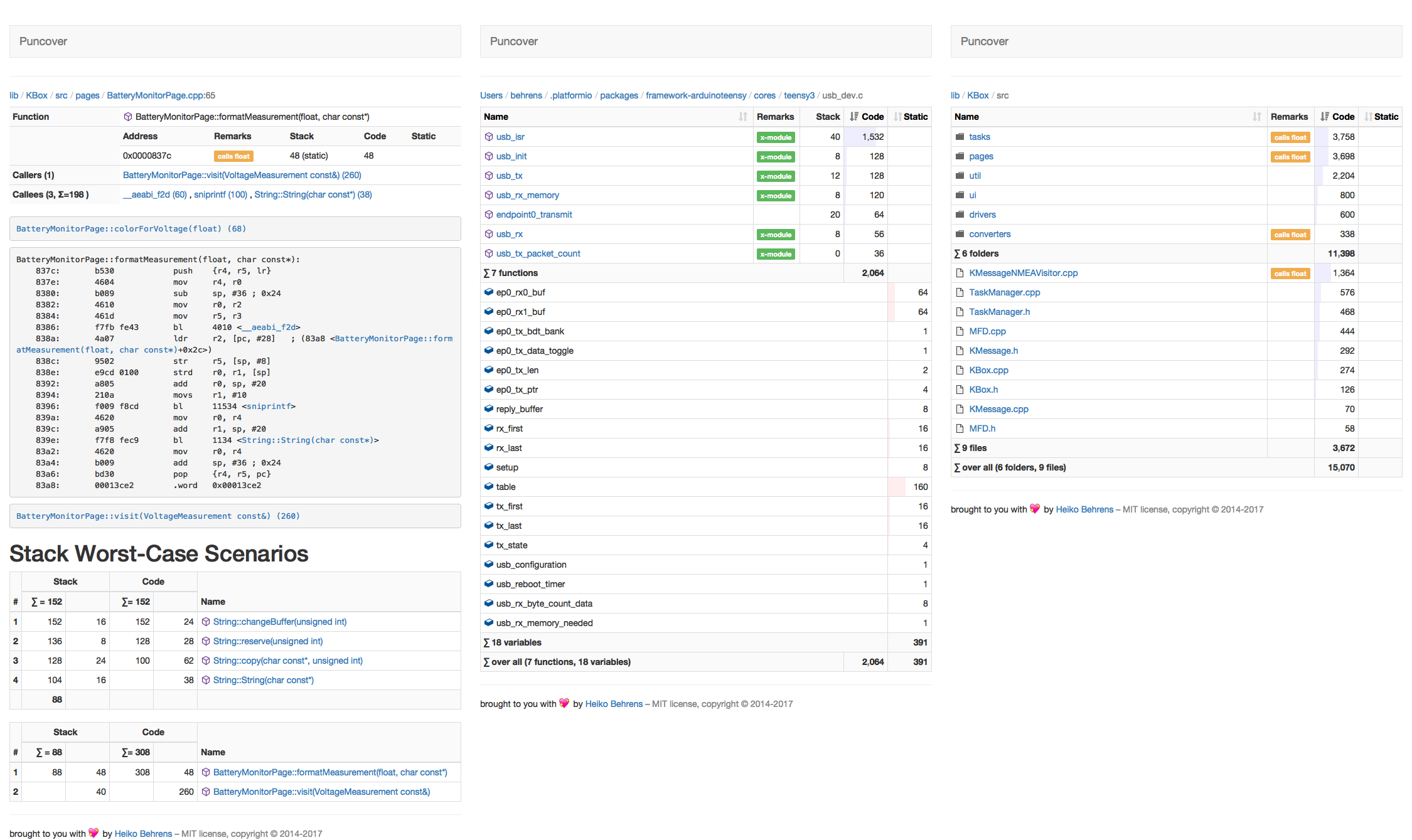
Analyzes C/C++ binaries for code size, static variables and stack usages. It creates a report with disassembler and call-stack analysis per directory, file, or function.
Install with pip:
pip install puncoverRun it by passing the binary to analyze:
puncover project.elf
...
* Running on http://127.0.0.1:5000/ (Press CTRL+C to quit)
Open the link in your browser to view the analysis.
You can also use uvx to run the script without installing globally:
uvx puncover project.elfTo run the tests locally, you need to install the development dependencies. This
project uses uv to manage the python environment.
uv venv && source .venv/bin/activate
uv syncThen you can run the tests with tox (note that this will fail if any of the
supported python versions aren't found, see tox.ini):
toxor, to target only the current python on $PATH:
tox -e pySee release.sh for a script that automates the above steps. Requires
uv to be installed. This example will work
with the PyPi tokens (now required):
PUNCOVER_VERSION=0.3.5 PYPI_TOKEN=<pypi token> ./release.shOnly for reference, the release script should take care of all of this.
Click to expand
-
Update the version in
puncover/__version__.py. -
Commit the version update:
git add . && git commit -m "Bump version to x.y.z"
-
Create an annotated tag:
git tag -a {-m=,}x.y.z -
Push the commit and tag:
git push && git push --tags -
Either wait for the GitHub Action to complete and download the release artifact for uploading: https://github.com/HBehrens/puncover/actions OR Build the package locally:
python setup.py sdist bdist_wheel -
Upload the package to PyPI:
twine upload dist/* -
Create GitHub releases:
gh release create --generate-notes x.y.z- attach the artifacts to the release too:
gh release upload x.y.z dist/*
Contributions are welcome! Please open an issue or pull request on GitHub.