







An open-source, code-first Python framework for building, evaluating, and deploying sophisticated AI agents with flexibility and control.
ADK in other languages: ADK Java, ADK Kotlin, ADK Go & ADK Typescript.
Agent Development Kit (ADK) is a flexible and modular framework that applies software development principles to AI agent creation. It is designed to simplify building, deploying, and orchestrating agent workflows, from simple tasks to complex systems. While optimized for Gemini, ADK is model-agnostic, deployment-agnostic, and compatible with other frameworks.
⚠️ BREAKING CHANGES FROM 1.xThis release includes breaking changes to the agent API, event model, and session schema. Sessions generated by ADK 2.0 are readable by ADK 1.28+ (extra fields will be ignored), but are incompatible with older 1.x versions.
-
Workflow Runtime: A graph-based execution engine for composing deterministic execution flows for agentic apps, with support for routing, fan-out/fan-in, loops, retry, state management, dynamic nodes, human-in-the-loop, and nested workflows.
-
Task API: Structured agent-to-agent delegation with multi-turn task mode, single-turn controlled output, mixed delegation patterns, human-in-the-loop, and task agents as workflow nodes.
-
Modular Multi-Agent Systems: Design scalable applications by composing multiple specialized agents into flexible hierarchies.
-
Rich Tool Ecosystem: Utilize pre-built tools, custom functions, OpenAPI specs, MCP tools or integrate existing tools to give agents diverse capabilities, all for tight integration with the Google ecosystem.
-
Code-First Development: Define agent logic, tools, and orchestration directly in Python for ultimate flexibility, testability, and versioning.
-
Agent Config: Build agents without code. Check out the Agent Config feature.
-
Tool Confirmation: A tool confirmation flow(HITL) that can guard tool execution with explicit confirmation and custom input.
-
Deploy Anywhere: Easily containerize and deploy agents on Cloud Run or scale seamlessly with Vertex AI Agent Engine.
You can install the latest stable version of ADK using pip:
pip install google-adkRequirements: Python 3.10+.
For transitive dependency protection, we recommend to install with our companion constraints files (for python 3.10 to 3.14).
Choose the constraints file matching your Python version:
# For example, for Python 3.10
curl -o constraints-3.10.txt https://raw.githubusercontent.com/google/adk-python/main/constraints-3.10.txt
pip install google-adk -c constraints-3.10.txt
rm constraints-3.10.txt
To install optional integrations, you can use the following command:
pip install "google-adk[extensions]"The release cadence is roughly bi-weekly.
Bug fixes and new features are merged into the main branch on GitHub first. If you need access to changes that haven't been included in an official PyPI release yet, you can install directly from the main branch:
pip install git+https://github.com/google/adk-python.git@mainNote: The development version is built directly from the latest code commits. While it includes the newest fixes and features, it may also contain experimental changes or bugs not present in the stable release. Use it primarily for testing upcoming changes or accessing critical fixes before they are officially released.
Beginner Note: ADK applications are built using two main classes:
Agent(defines an AI's instructions, tools, and behavior) andWorkflow(orchestrates agents and tasks in a graph-based flow).
from google.adk import Agent

root_agent = Agent(
    name="greeting_agent",
    model="gemini-2.5-flash",
    instruction="You are a helpful assistant. Greet the user warmly.",
)from google.adk import Agent, Workflow
generate_fruit_agent = Agent(
name="generate_fruit_agent",
instruction="Return the name of a random fruit. Return only the name.",
)
generate_benefit_agent = Agent(
name="generate_benefit_agent",
instruction="Tell me a health benefit about the specified fruit.",
)
root_agent = Workflow(
name="root_agent",
edges=[("START", generate_fruit_agent, generate_benefit_agent)],
)# Interactive CLI
adk run path/to/my_agent
# Web UI (supports multi-agent directories or pointing directly to a single agent folder)
adk web path/to/agents_dirA built-in development UI to help you test, evaluate, debug, and showcase your agent(s).
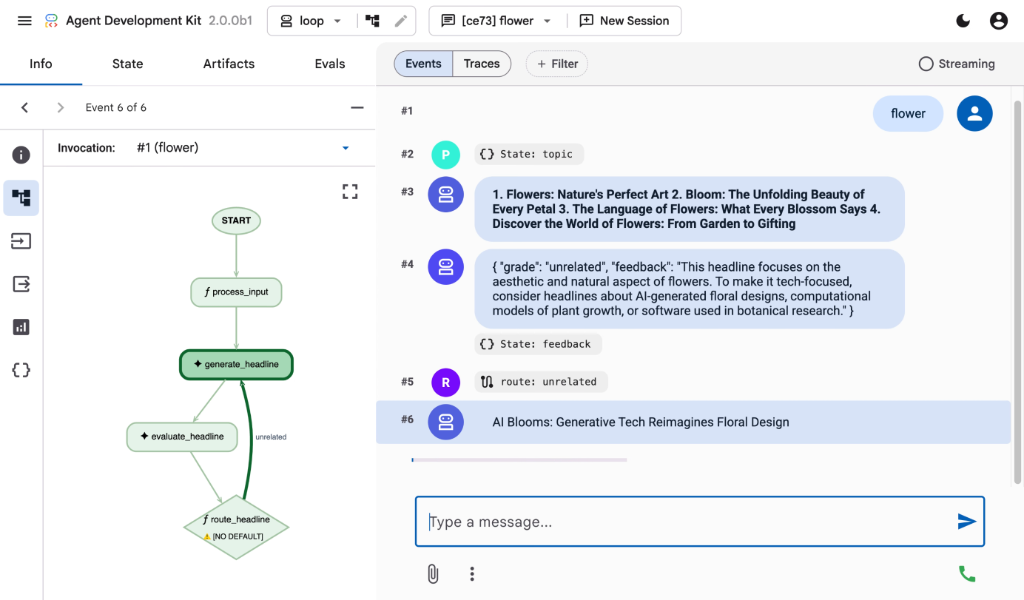

adk eval \
    samples_for_testing/hello_world \
samples_for_testing/hello_world/hello_world_eval_set_001.evalset.json- Getting Started: https://google.github.io/adk-docs/
- Guides: See
docs/guides/for task-oriented walkthroughs of agents, tools, events, plugins, and workflows. - Samples: See
contributing/samples/for runnable example agents.
We welcome contributions from the community! Whether it's bug reports, feature requests, documentation improvements, or code contributions, please see our:
- General contribution guideline and flow.
- Code Contributing Guidelines to get started.
We have adk-python-community repo that is home to a growing ecosystem of community-contributed tools, third-party service integrations, and deployment scripts that extend the core capabilities of the ADK.
If you want to develop agent via vibe coding the llms.txt and the llms-full.txt can be used as context to LLM. While the former one is a summarized one and the later one has the full information in case your LLM has big enough context window.
- [Completed] ADK's 1st community meeting on Wednesday, October 15, 2025. Remember to join our group to get access to the recording, and deck.
This project is licensed under the Apache 2.0 License — see the LICENSE file for details.
Happy Agent Building!