The purpose of this project is to demonstrate how reinforcement learning can be used to train an AI Agent/Player in a custom home-built python game

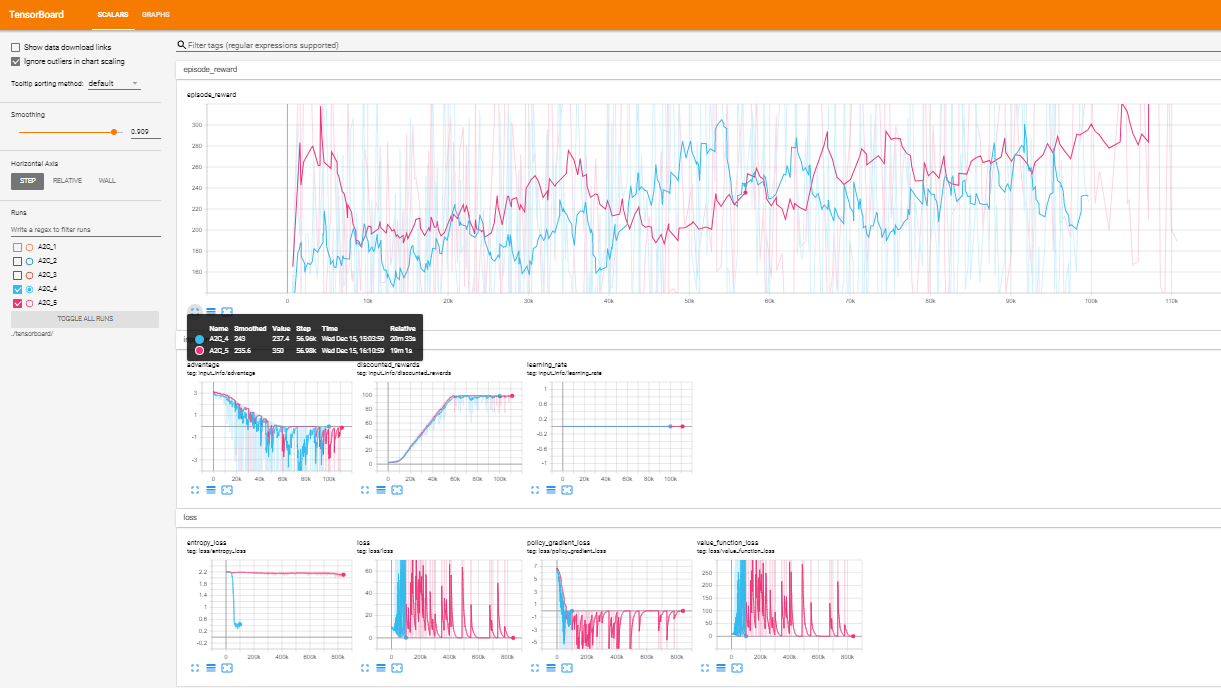
Once training has started, you can monitor via tensorboard with the following command:
tensorboard --logdir './tensorboard/'The objective of the game is to live as long as you can, while avoiding the asteroids in the Kuiper Belt. The player starts centered in the screen, an can move in any direction using the keyboard arrows. Asteroids are generated with random sizes, speeds, and starting locations. The game ends once all player lives have expired.
Check out the repo for the custom Open AI Gym environment using PyGame framework:
👉 👉 👉 👉 Custom PyGame Open AI Gym Environment - Kuiper Escape 👈 👈 👈 👈
The user has the following discrete actions:
- 0: Don't move
- 1: Up
- 2: Right
- 3: Down
- 4: Left
- 5: Up/Right Diagnal
- 6: Right/Down Diagnal
- 7: Down/Left Diagnal
- 8: Left/Up Diagnal
The state/observation is a "virtual" lidar system. It sends off virtual beams of light in all directions to gather an array of points describing the distance and characteristics of nearby objects. The size of the lidar array and resulting observation/state space is configurable when the environment is initialized
The observation data (for each beam in the lidar array):
- Distance (i.e. radial distance from player to terminating point of lidar beam)
- Collision detection
- 0 if terminated at edge of screen, or at max radius distance
- 1 if collided with a rock
Example Visualizations of State


Note: The yellow dots (1 collide state) represent contact with a rock, the green dots (0 collide state) represent contact with wall or open space.
The environment will provide the following rewards:
- Reward of 1 for each step without losing life
- No reward is given if the player is in the corners of the screen
First it is recommended to setup a virtual environment:
python -m venv .env
source .env/bin/activate
Update pip and wheel to ensure a smooth installation process:
pip install --upgrade pip
pip install --upgrade wheel
Finally, install package locally with pip:
git clone https://github.com/jdegregorio/gym-kuiper-escape.git
pip install -e gym-kuiper-escape
To uninstall, use the following:
pip uninstall gym-kuiper-escape- Python Version: 3.8.10
- Operating System: Ubuntu 20.04.3 LTS
Open AI Gym provides a standardized framework for training reinforcement learning models. The framework has numerous built-in environments (often games) for experimentation, but also enables users to define their own custom environments.
- Open AI Gym Documentation
- Creating Customer Environments
- Example Custom Environment
- Core Open AI Gym Clases
PyGame is a framework for developing games within python.
This tutorial is a great primer for getting started.
Stable baselines was the primary reinforcement learning framework used for this project. It provides a great set of algorithms and monitoring tools to get started. Future work on this project will explore other packages such as Acme.